


OUTSIDERS
- Sara Bell
- Aug 24
- 6 min read
“Come, see a Man who told me all things that I ever did. Could this be the Christ?”
John 4:29
When you buy into the social contract, what does that mean? What does it mean to be an insider or an outsider? How do you categorize such things? If you believe there are those who are “in,” can you recognize someone who is “out”?
I find that these are sort of intuitive groups. Whatever group you consider yourself to be a part of, it is easy to recognize one who is not a part of the group. Categorization is something our human brains do automatically. We shuffle all of our existence into one category or another. Safe versus unsafe. Happy versus sad. It can be difficult to train our brains to see nuance in our own existence.
As a general rule, societies are made up of several strata of people. No matter how utopian we strive to be, like-minded people will group together. We don't like to admit it, but humans tend to gather in cliques. It feels much safer to move about the world as a part of a crowd. Often, how we treat others depends on how we view ourselves in relation to others.
In the best cases, groups can perform great acts of kindness & rescue. My favorite stories are those of hope & help, where a group of people made an outsize impact in the wider world. I'm a product of the generation who experienced We Are the World & LiveAid in real time. A handful of well-known musicians & superstars came together to raise money to fight actual world hunger. They spearheaded campaigns to raise astonishing amounts of money to feed people who would otherwise starve in famine-blighted places. (I know this is complicated for modern sensibilities, but 40 years ago, it was earth-shaking. For now, let's agree to just look at it for the good people endeavored to do.)
One of my favorite news magazines regularly features stories like this. They always prompt me to turn to John–usually with tears in my eyes–and proclaim the goodness of people, my faith in human decency restored.
The bottom line of all these stories is dignity. When we see those around us as people with inherent value, we tend to treat them with dignity.
In the worst cases, groups become mobs capable of great violence we wouldn't conceive of on our own. It is so easy to follow the crowd when there's a sense of anonymity. We’ve all heard stories or seen the news segments where a noisy but peaceful crowd of people suddenly becomes a dangerous mob. Even the word mob sounds sinister. Bad things happen where basic human decency ebbs away.
When we group someone into the category of “other” it is easy to depersonalize that individual. Picture the Civil Rights movement here in the US. For generations, segregation and racist ideology did more than separate Black Americans from white Americans. This mindset actually reinforced the idea that Black people were fundamentally different, inferior. This view made it easy for white people in America to dehumanize an entire ethnic race of people.
It's not a uniquely American issue. This happens around the world and has been going on as long as there have been records of humanity. Once a person is reduced to anything less than a whole human being--one with a story, with loved ones, with hopes and fears and joys--it becomes easier to tolerate injustice against them. There is inherently a distance and devaluing in seeing someone as a less-than-person label.
Human brains find danger on the outside of such a group.
I recognize that I'm painting in very broad generalities. That's my intent. In your own mind, put yourself into each of these scenarios. What does it feel like to be in the middle of the group?
Now place yourself outside the group looking in. What does it feel like to see a group who are willing to help when you're in need? Conversely, what does it feel like to be on the outside of a mob bent on destruction?
There are lots of stories of outsiders in the bible. Let’s meet a few of them.
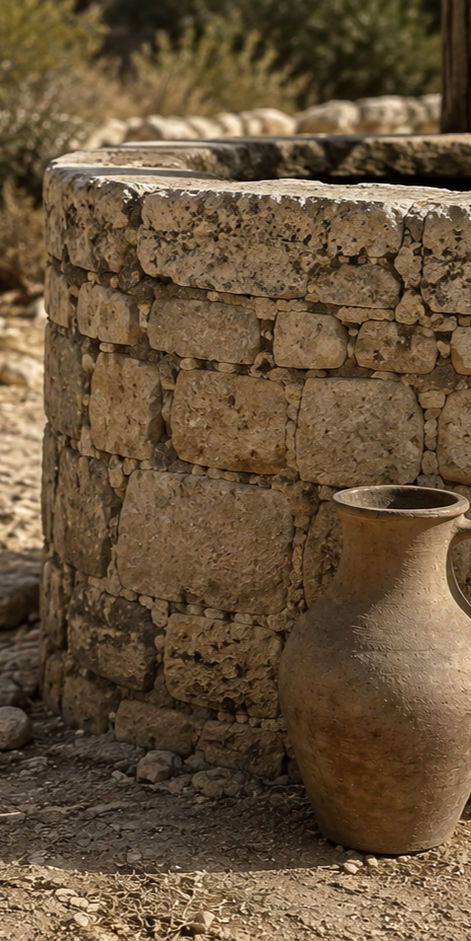
In John 4, we drop into a story about Jesus’ conversation with a Samaritan woman who comes to the well where He is sitting. This woman is a reluctant storyteller, unwilling to share details of her life with this stranger who asks too many personal questions. Jesus, however, is patient to sit with her there in the middle of the day, in the middle of her shame. He makes it clear He knows her story because He tells her about her own past.
She is an outsider in her own story: a Samaritan, a woman, in conversation with a Jewish man. She carries the weight of a story that has pushed her to the margins of her own community. There are plenty of reasons this conversation should never have happened.
Instead, Jesus is right there, waiting just for her, almost as if He planned it (John 4:4).
Jesus deliberately crossed convention & categories to meet this woman. He didn’t wait for her to change. He met her exactly where she was.
And then something remarkable happens: She becomes the first person to take the good news of this Man who could be the Messiah to her town. Following their conversation, she leaves her water jar, rushes back to the town full of people she’s been trying to ignore and says, “Come, see a Man who told me all things that I ever did. Could this be the Christ?” (John 4:29)
The outsider becomes the one inviting others in.
And they came.

We find another outsider in 1 Kings 17:8-16 where a widow provides food for a man of God named Elijah. This woman & her son live in a city called Zarephath outside of Israel. When we come into her story, she is gathering sticks to build a fire so that she can cook one more meal for her son and herself, after which she expects they will die. There is a great famine in the area so the food is gone.
God had a different plan for her, though.
Elijah tells her to make food for him first, then to make some for herself and her son. If she will do this one thing for God’s prophet, then God Himself will provide for her until the rains return & she can provide for herself once again.
But God didn’t just provide for this outsider. He chose her.
Centuries later, Jesus points back to her story as He talks to the people of His own hometown. He reminds them that during the famine, God sent Elijah to a widow in Zarephath of Sidon, NOT to a widow in Israel. God can and does choose outsiders to accomplish His plans. His point makes them so angry that they try to kill Him. (Luke 4: 22-30)
Jesus knew that God has never been especially interested in our categories of who is “in” and who is “out.”

Naaman seems like exactly the opposite of an outsider. We meet this commander of the Syrian army in 2 Kings 5:1-19. He is a, “great and honorable man in the eyes of his master.” Also, “a mighty man of valor, but a leper.” In an unlikely twist, an Israelite servant girl points Naaman toward Israel and Elisha for healing. With hopeful intent, Naaman travels there looking for healing. But Elisha sends out his own servant with instructions for Naaman to wash in a dirty river to become clean. Reluctantly, he does and is healed.
Naaman had everything that should have made him an insider: power, wealth, influence. But he was made an outsider because of his disease.
Naaman comes to Israel expecting things to work a certain way, but they don't.
Naaman comes looking for healing and leaves having encountered the almighty God of Israel.
God didn’t require anything of Naaman except humility and obedience. Once he humbles himself and follows simple instructions, God rushes in with a miracle for a man who thought he was an insider.
Until he encounters God.
Naaman came to Israel looking for something only God could do for him.
He left knowing the One and Only God. (2 Kings 5:15)
We’ve met three outsiders with three very different stories: a Samaritan woman in Jesus’ time; a widow in ancient Sidon; a Syrian army commander. On the surface, we might be able to swiftly sort them into the categories of “Insider” and “Outsider.” Yet none of them fit neatly into one or the other.
The thing they have in common is the thing that is most important to each of their stories: God met every one of them. He met them in shame, in desperation, in sickness. He met them as “outsiders” and none of them had to find their way “inside” first.
Do you feel like you are inside looking out? Outside looking in?
Let me be the one to challenge your standing today: we are all outsiders at some point.
For those of you who think you’re an insider, I pose the question: Who will you bring inside with you?
If you’re convinced you’re standing on the outside, I want to be the one who invites you to come inside today.
Like the woman at the well, I invite you to come and see.
God will meet you in your story, too.

What a beautiful reminder that God will meet us where we are. We just have to be willing to humble ourselves and open our hearts!