


STORY
Updated: Sep 13
Joshua 4:21–22
“Then Joshua said to the Israelites, *‘In the future your children will ask, “What do these stones mean?” Then you can tell them, “This is where the Israelites crossed the Jordan on dry ground.”

“Once upon a time” might be the most charmed words of our childhood. Those four words have launched ships, rescued princesses, and built tree forts out of blankets and pillows on the living room floor. A thousand different stories told, all starting in the same way.
Even if those words aren’t written at the beginning of every book, they’re implied. That’s the nature of storytelling.
Because humans are storytellers.
Since the beginning, people have shared stories for a variety of purposes. Mothers warned their children through stories. Friends frightened each other in the dark. Even now, we narrate our lives through an inner monologue.
The stories we tell validate our experiences. We replay moments to test what’s true, learn from pain, evaluate an exchange, or preserve a memory so our future self can return to it.
I come from a family of storytellers. Boy howdy—when my people gathered around a table of food, they could talk and laugh for hours. I don’t always remember the content of their stories, but I remember their joy in shared memories.
Those Sunday afternoons around the dinner table were precious to me because that’s how I learned my family—who my parents and grandparents, aunts and uncles were *before I was born*.
I may not recall every story with precision, but I know the general shape of my family’s recent history because of those conversations. I know the town where my Papaw grew up because I heard stories about the family farm in southern Ohio. I heard the story about how his daddy had his arm cut off by his own twin brother while they were chopping wood. I know my mama’s grandfather carried an icebox on his back to my mom’s mom before refrigerators were common in rural West Virginia. That same icebox sat in my mama’s kitchen until just a few years ago—something I could see, touch, and point to while asking, “Tell me that story again…”

The best stories are show-and-tell because we often have a “device” that triggers recall.
People lean into nostalgia when they tell stories about where they were traveling when they got a tchotchke or a ball cap. John and I started a tradition long ago of collecting sand or a rock when we travel. I’m currently filling our fifth bottle of sand—one layer, one vacation, one memory at a time. I can recreate more than a decade of travel by revisiting layers of colors and textures in the other bottles.
Lots of people carry their stories in their skin through scars and tattoos. For much of history, scars were a legacy of battles survived or illness overcome. They told the story of the body’s ability to heal. I can probably tell you the story behind every scar and stretch mark I carry—lessons I’ve learned and children I’ve borne.
And in my lifetime, it’s become common to mark milestones with tattoos. Every one of my children has tattoos, and they can tell you what each one means—what season of life it represents.
But here's the thing. Scars fade. Tattoos blur. People die. And if the story isn’t told—if it isn’t passed down—what once held meaning can start to look like junk destined for donation or trash.
Let me tell you a little story about the Israelites at the beginning of the book of Joshua.
The people of God have just crossed the Jordan River after 40 years in the desert wilderness. During those 40 years, they lost an entire generation—the elders who were rescued out of slavery in Egypt died. Their lived experiences died with them. But this was a time of the oral tradition of storytelling. The only way to record these stories was to remember them and tell them over and over again.

Now the children of that generation who came out of Egypt are moving into a land they’ve heard about all their lives: the Promised Land. This is the place God has promised to establish them as a nation. Their parents spoke of it. Moses constantly reminded them of this land. Their parents had even stood across the river before, but they didn’t trust God’s promise to bring them into the land, so that generation lost the blessing of setting foot on the land of God’s promise.
Here at the beginning of the book of Joshua, we follow a new generation of God's chosen people. They're crossing that river on dry land, just like their parents walked out of Egypt through a dry seabed. They will no longer be nomads, wandering in the desert and camping under a supernatural pillar of fire and cloud. Because of their storytelling tradition, they remember the stories of Abraham, Isaac, and Jacob. Stories that had been passed down for 400 years as they lived and slaved in Egypt about a good, abundant land flowing with milk and honey. God declared to the patriarchs He would bring them to this place. He would give them a permanent address here.
And now they’ve arrived.
But before they move forward, Joshua says they must look back. They must remember where they’ve come from. Moses did this first in the book of Deuteronomy (just before the book of Joshua). Moses looks back on the 40 years since God delivered them from Egypt. He recaps where they've been, how far they've come in relationship with Yahweh and what must remember as they move forward into the land of God's Promise.
Moses and Joshua tell the people of Yahweh: Remember who brought you this far.
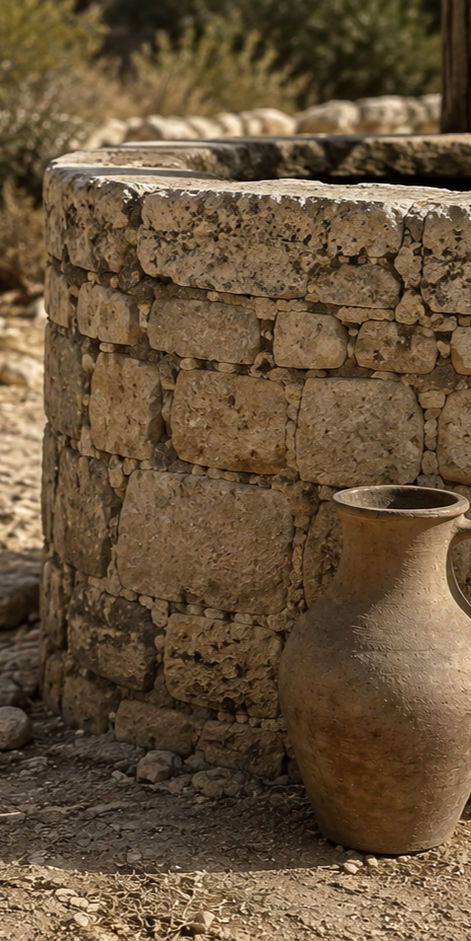
At this point in the story, Joshua calls twelve men—one from each tribe—and tells them to choose a stone from the dry bed of the Jordan River. Those stones are to be carried to the other side of the river and stacked.
Picture it: The priests bearing the Ark of the Covenant stand in the middle of the riverbed where it's maybe 10 feet deep. Upriver, the water has piled up like a pane of glass is holding it in place. Downriver, maybe the water has kept flowing away leaving mud & gasping fish. The millions of people walking through this riverbed are looking down at their feet in dry dirt, like there has never been a drop of water in the riverbed. When everyone is across, (hours later?) Joshua directs these twelve men to go back down and bring up one stone each. After these men come back to the Promised Land side of the river, the Levites bearing the Ark come up from the riverbed, too. As soon as the last foot leaves the riverbed, the waters fall back into place as if they never left it.
Can you see it all happening?
Joshua, with his back to a noisy river flowing at flood stage, points to the stack of big rocks and tells this nation—millions of people—to look at these stones and remember their stories. He says when their children ask what this big stack of twelve rocks means, be sure to tell them:
This place right here is where God answered His promise to us.
He brought our parents and grandparents out of slavery in Egypt by exhibiting His power over the gods and rulers of that land. He led us through the wilderness in spite of all of our grumbling and complaining and our own flawed, short-sighted humanity. And here is where we first experienced His promise fulfilled in the form of land to inhabit and call our own.
This big stack of rocks represents God's faithfulness.
So the next time you tell the story of that tattoo, that scar, or that little doodad from “This one time,” think of how God is represented in your story.
Did He walk with you?
Did He rescue you?
Did He lead you all the way?
Are you still looking for God in your story?
He is in the business of reclaiming the “wilderness years” of your story—the seasons where relationships were severed, people died, dreams fled, and you weren’t sure you’d make it out.
God can give meaning to those lost years and bring healing to your soul.
I speak from experience. He did that for me.

So the next time we meet, I’m going to point to a big stack of stones that might, at first glance, look a lot like rubble. But I’ll tell you my story and I’ll be sure to tell you where I saw God.
I don’t mind going first if that makes it easier for you.
I hope you’ll tell me your story too.
And if you can’t see God yet—just keep looking.
We can find Him there together.

If this message resonated with you, we dive even deeper into topics just like this on the Faith Unfiltered Life Podcast. Tune in as we share unfiltered conversations about faith, grace, and what it really looks like to follow the Shepherd. Click the link to listen to our latest episodes!


Comments